English
 中文简体

News
Home > News > Industry News > How to Choose Airless Bottles Manufacturers: Specs, Materials and Sourcing

 2026.10.15
 Industry News
Content
A buyer emails the same brief to five airless bottles manufacturers: 30 ml, frosted finish, 0.25 ml dose, serum viscosity around 8,000 cps. Four quotes land within 15% of each other. The cheapest one ships bottles whose pump returns 0.22 ml per stroke, and the brand discovers this only after 20,000 units are filled and labelled.
That gap is the whole story of sourcing airless packaging. An airless bottle is a mechanical system, not a decorated container, so the decision should rest on four verifiable things: dose accuracy, material and piston compatibility with your actual formula, refill or multi-chamber architecture, and documented quality control. Catalogue width, render quality and sample turnaround matter, but none of them predicts what happens on your filling line.
An airless bottle holds the formula under constant pressure, so the product rather than air follows the piston up the chamber. With no dip tube and almost no headspace, the formula meets very little oxygen across its shelf life, which is why the format dominates retinol serums, vitamin C concentrates, peptide creams and tinted foundations.
What you gain is less oxidative stress on actives, a lower preservative load, and evacuation rates that commonly reach 90 to 95 percent of fill. What you give up is unit cost, filling simplicity, and any tolerance for formulas the pump cannot move.
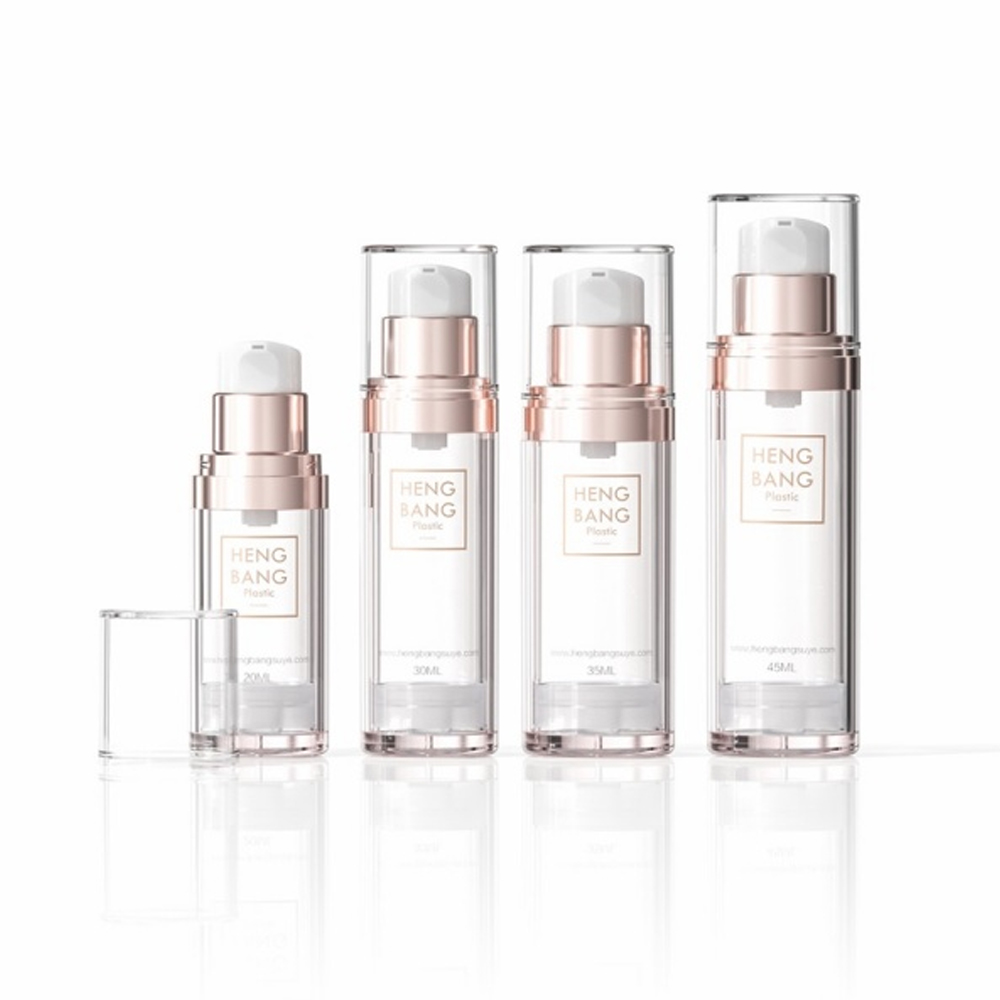 Plastic Airless Bottles for Cosmetics and SkincareWholesale category for plastic airless bottles, including piston and bag-in-bottle options for foundation, lotion, and serum packaging.View Product →
If you want the mechanism in more detail before writing a specification, our note on how a plastic airless bottle works walks through the piston and valve sequence step by step.
Agree on dose, viscosity range and usable capacity first. These three numbers decide whether the pack works at all, and they are the least expensive things to change while you are still at sampling.
Dose. Production airless pumps are generally offered between 0.10 ml and 0.50 ml per stroke, with 0.20 ml and 0.25 ml the most common for facial serums and foundations. Ask for tolerance in writing; plus or minus 10 percent at 20 to 25 degrees C is a reasonable baseline. Then ask whether that tolerance holds at the end of the bottle's life, because dose often drifts as the piston loads.
Viscosity. The same 30 ml body can be fitted with a thin-liquid piston, a cream piston or a high-viscosity piston. Change the formula and you may need to change the piston and re-validate the dose, even when the bottle itself stays identical.
Usable capacity. A 30 ml airless bottle is nominal. Fill volume is usually 85 to 95 percent of nominal to leave room for the piston and the headspace the filling machine needs, so a 30 ml pack carries roughly 26 to 28 ml of product. If a label promises a 30-day supply at 0.5 ml per use, check the arithmetic against usable capacity before printing.
Typical airless dose per stroke by product type (ml, illustrative)
Choose the material from formula chemistry, decoration plan and retail price band, not from a photograph. In airless packs the outer shell and the wetted parts are often different plastics, and the wetted parts matter more.
| Material | Typical airless use | Strengths | Watch-outs |
|---|---|---|---|
| PETG | Lotion and toner bottles, travel sizes | Clear, good chemical resistance, moderate cost | Can craze with aggressive solvents; less premium than acrylic |
| Acrylic and AS | Double-wall cream jars, premium airless shells | Glass-like clarity, scratch resistance, heavy-wall look | Higher cost, more brittle, decoration needs care |
| PET | Toner and low-viscosity formats | Good barrier, low cost, recycled grades available | Limited design freedom; not ideal for thick creams |
| PP | Pumps, pistons, inner cartridges | Excellent chemical resistance, low cost, strong structural parts | Opaque, low clarity |
Two clarifications prevent rework. First, confirm which parts touch the formula, namely chamber, piston and outlet valve, because an acrylic shell often sits over a PP cartridge. Second, decoration affects performance: spray coating and metallizing extend lead time and can complicate recyclability claims, while hot stamping on a curved airless shoulder needs a dedicated jig.
Refill and multi-chamber formats are the two designs that usually justify a premium, and both push more mechanical risk onto the supplier. Judge them on tolerances rather than on concept.
A refillable airless bottle keeps the outer shell and pump and replaces the inner cartridge. Material use per cycle falls, refills can be sold at retail, and the premium surface stays in the customer's hand. The trade-off is dimensional discipline: the cartridge neck and the shell seat must hold a tight fit, or the pack weeps at the joint after the second or third refill. Ask what that fit tolerance is and how it is checked in production.
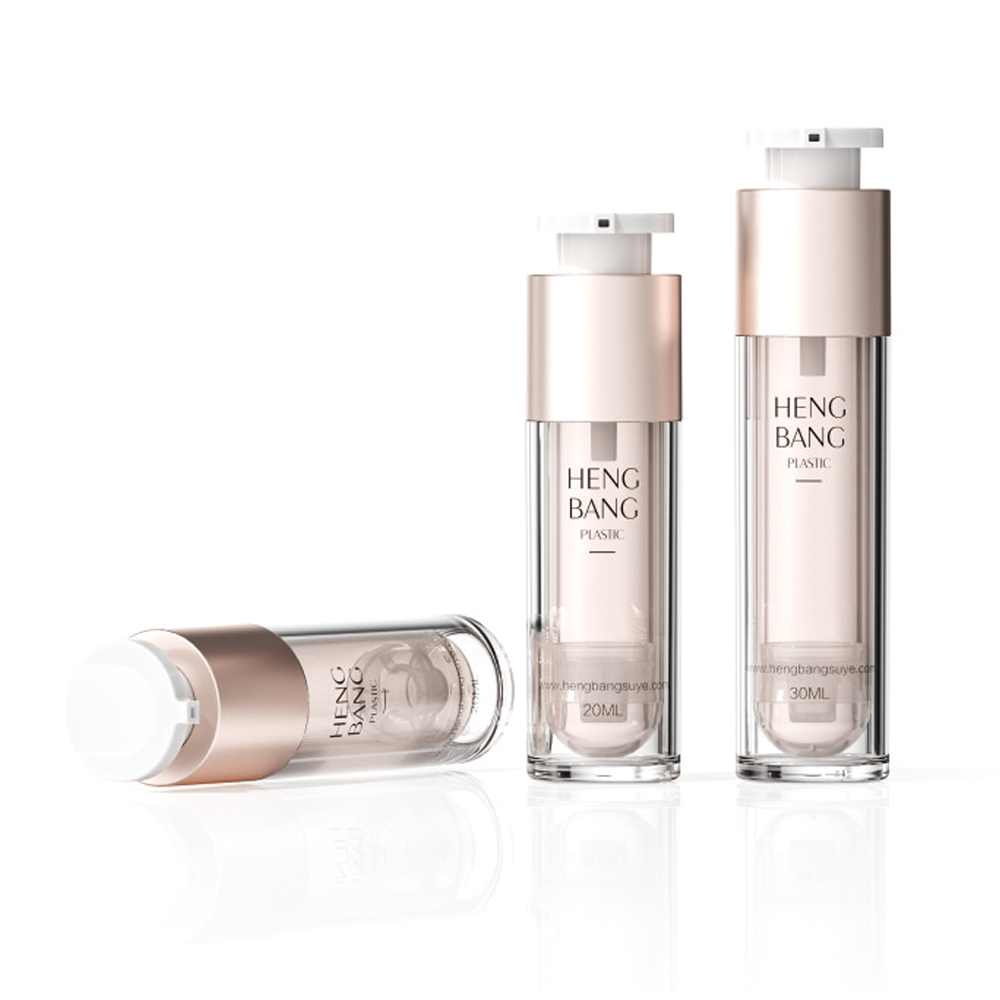 Plastic Refillable Airless Bottles for Serum and SkincareRefillable airless serum bottles use replaceable inner cartridges and permanent pump shells to reduce packaging waste while preserving active formulas.View Product →
Multi-chamber packs dispense two or three formulas from one unit, or keep actives separate until the moment of use. Chamber capacities commonly run from about 7 ml to 28 ml each, so a double chamber pack might hold 15 ml plus 15 ml, or 24 ml plus 4 ml for a booster. Test two things before committing: that the ratio between chambers stays stable as the pack empties, and that nothing seeps between chambers during storage or transit.
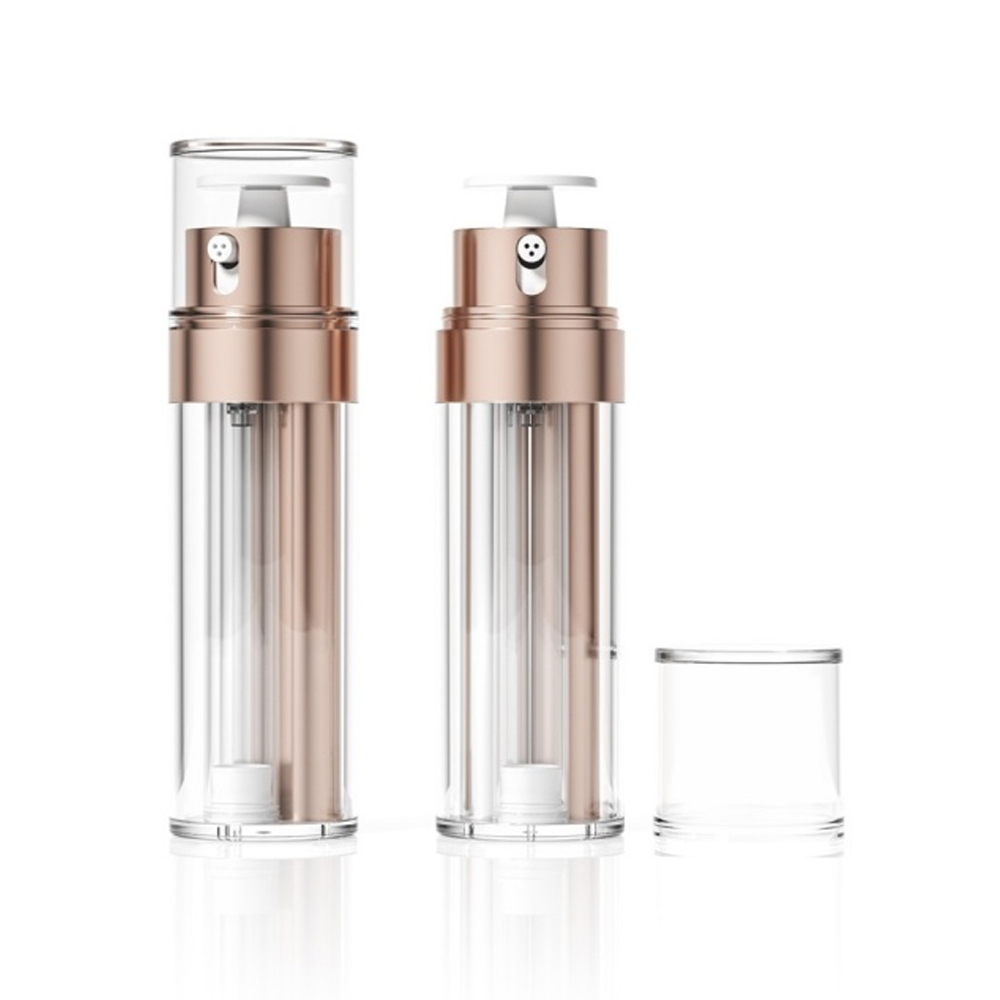 HB-S007 Triple Chamber Airless Bottle 30mlModel HB-S007 uses three isolated chambers and a multi-stream pump to dispense incompatible skincare formulas together in a preset ratio.View Product →
Ask for documents and test data rather than assurances. The list below follows the order in which problems usually surface.
One further filter saves months: ask who moulds the wetted parts and who makes the pump. A manufacturer that moulds the bottle, sources the pump and assembles both is accountable for the whole system. A supplier that only moulds the shell will point at the pump vendor the moment the dose drifts.
Airless bottles manufacturers earn their place on the same four criteria regardless of size: dose accuracy with your formula, material and piston compatibility, refill or chamber architecture that holds its tolerances, and quality records you can audit. A supplier that answers those questions with numbers and test data will beat one that answers with a catalogue.
Our own plant in Yuyao, Zhejiang covers 35,000 sq m with more than 300 staff and holds ISO 9001:2015 and ISO 14001:2015 certification. We mould, decorate and assemble airless bottle packs from 7 ml multi-chamber units up to 50 ml suncare bottles, and we would rather validate a dose against your formula at sample stage than explain a drift after mass production.


Copyright © Yuyao Hengbang Plastic Co., Ltd.
All Rights Reserved.
 Wholesale Plastic Cosmetic Packaging Manufacturers