English
 中文简体

News
Home > News > Industry News > Custom Lotion Jars: Sizes, Materials, and Complete Sourcing Guide for Brands

 2026.10.08
 Industry News
Content
A 200 ml body lotion jar that starts weeping around the thread after six weeks on a shelf almost never fails because the plastic was cheap. It fails because the neck finish, the liner and the formula were specified by three different people at three different times.
Here is the short version before the detail: choose the format from the formula first, treat the neck finish and the liner as one sealing system, and only then decide wall style, decoration and price. That order removes most lotion jar problems before anyone cuts a mould.
What follows is what actually matters when you buy an empty lotion jar: fill volumes, material trade-offs, refillable options, tolerances, decoration and the checks worth running before you approve a sample.
Suppliers quote a jar by its nominal capacity. Your customer experiences the fill volume. Leave 8 to 12 percent headspace so the liner never touches the product, the jar does not overflow on a standard filler, and a jar filled to the shoulder still closes cleanly.
Two practical consequences. A jar sold as 250 ml normally carries 220 to 230 ml of body lotion, so a formula sheet built around 250 ml will come up short at the filling line. And a jar filled right to the rim photographs well but splashes on first use, which tends to surface in reviews rather than in a lab report.
Neck finish is the other half of the sizing decision, and it is where most mismatches begin.
| Fill volume | Common neck finish | Typical closure | Standard liner |
|---|---|---|---|
| 15-30 ml | 43/400 | Screw cap, 43 mm | PE foam |
| 50 ml | 53/400 | Screw cap, 53 mm | PE foam or induction seal |
| 100 ml | 63/400 | Screw cap, 63 mm | PE foam |
| 150-250 ml | 70/400 | Screw cap or disc-top | PE foam or EPE |
| 200-500 ml | 89/400 | Screw cap, 89 mm | EPE or induction seal |
Where possible, buy the cap and the jar from the same family. A 70/400 cap from one factory and a 70/400 jar from another usually seal, but the window between leaking and cracking the shoulder narrows, and that window is where filling-line rejects come from.
The fastest way to settle the format question is viscosity, and it is worth drawing the decision rather than arguing about it.
Below roughly 10,000 cP the product pours, so a bottle or an airless pump delivers a cleaner dose with less air contact. Above roughly 25,000 cP the product does not move on its own, and a wide-mouth jar with a spatula or a fingertip is the natural package. Between those numbers both formats work, and the decision shifts to consumer habit, unit dose and how much preservative system you want to carry.
Changing the format also changes the filling line, the carton and the shipping test. A jar needs a wide-mouth filler and a larger shelf footprint; a bottle needs a different nozzle and usually a smaller outer carton.
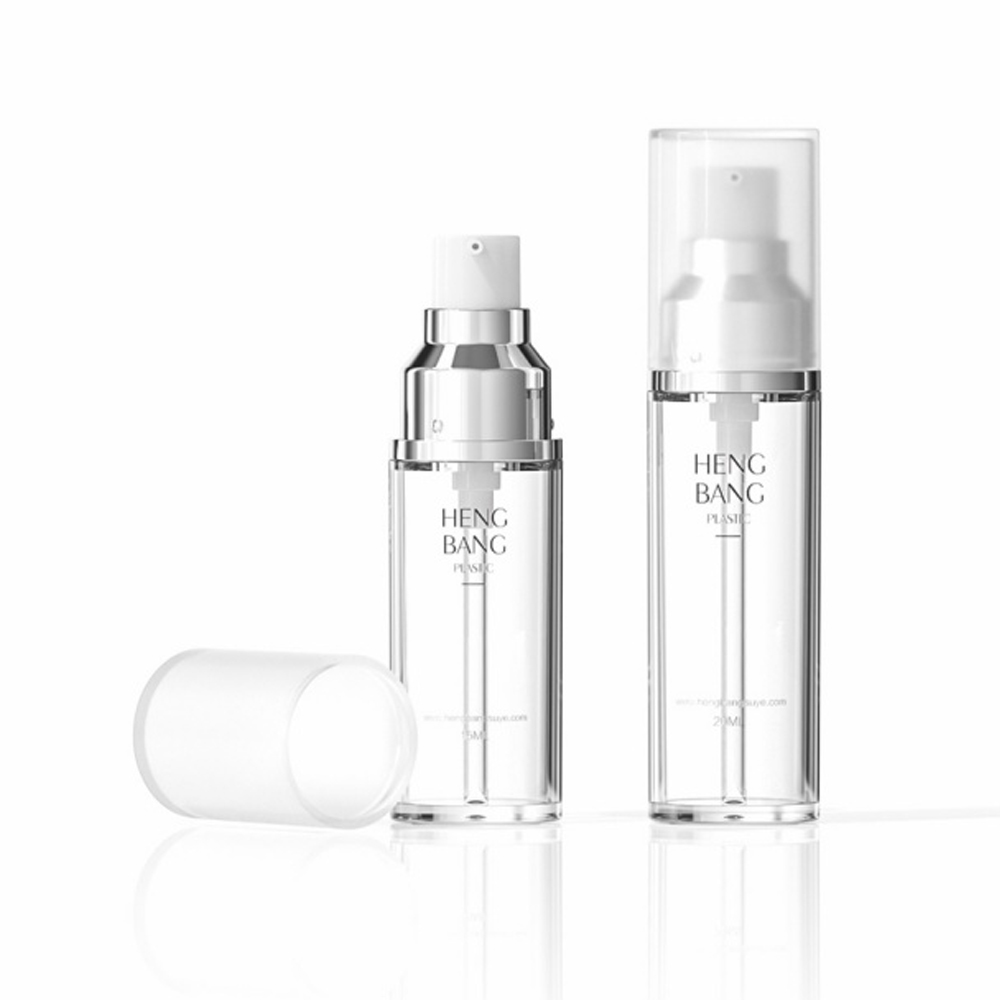
Travel sizes are where the question comes back. A 30 to 50 ml PETG lotion bottle generally survives parcel shipping better than a small thick-walled jar, and it accepts a disc-top or flip-top cap that a jar cannot.
 HB-R007 Custom PETG Travel-Size Lotion BottleA 15–20 ml PETG lotion bottle for on-the-go skincare, with TSA-compliant sizing and disc- or flip-top cap compatibility.View Product →
Material is where the visible complaints start: crazing around the thread, a jar that panels after a month, a frosted surface that turns cloudy after one wipe with alcohol.
| Material | Clarity | Chemical tolerance | Best suited to | Relative cost |
|---|---|---|---|---|
| PP | Translucent to opaque | High | Body lotion, scrub, most formulas | Low |
| PET | High | Moderate | Clear jars for pourable lotions | Low to medium |
| PETG | High | Moderate to high | Thick-wall clear jars, premium look | Medium |
| Acrylic (PMMA) | Highest | Low to moderate | Face cream, gift sets, retail display | High |
| PCR PP | Opaque | High | Refill cups and recycled-content lines | Medium |
Compatibility should be tested with the finished formula, not with water. Four weeks at 40 degrees Celsius plus a freeze-thaw cycle exposes crazing, paneling and stress cracking long before a shelf does, and it costs a fraction of a product recall.
If you are still weighing acrylic against refillable types, the note on material options for plastic cream jars covers the same ground from the mould side.
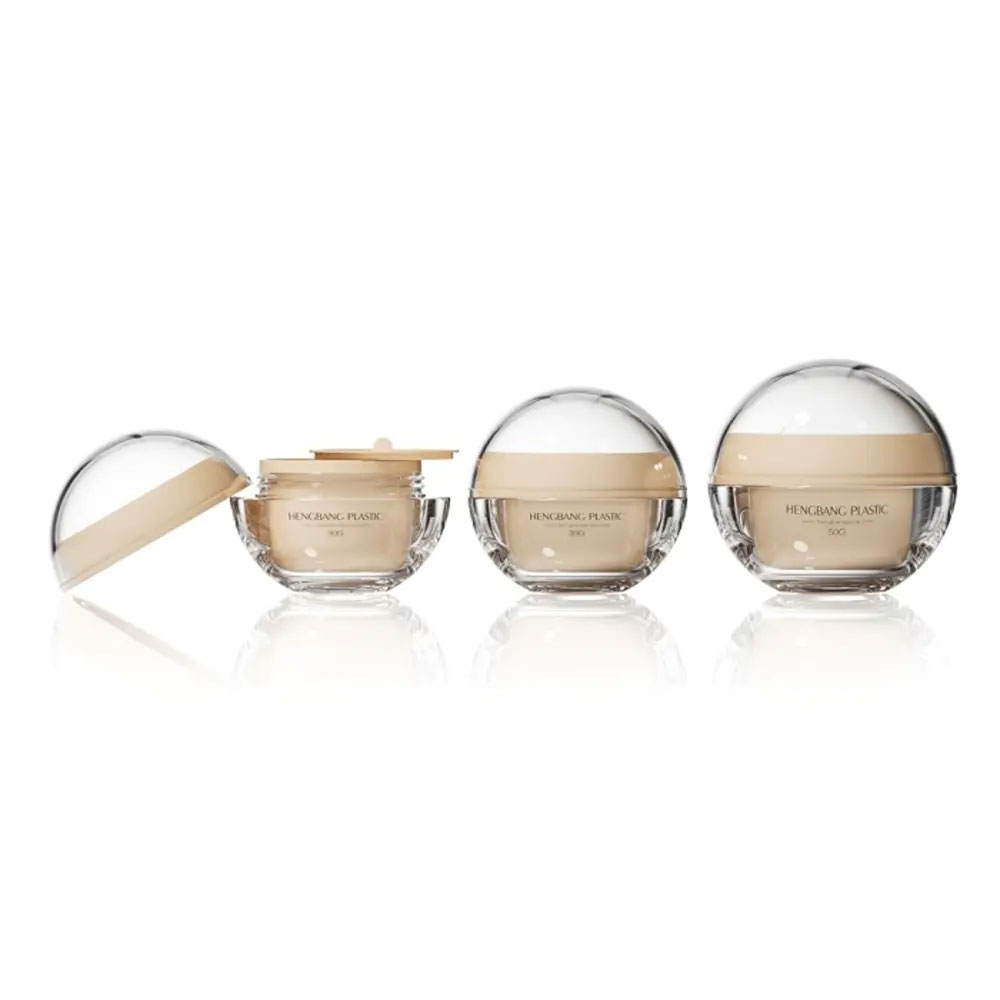 HB-G002 Double-Wall Spherical Acrylic Cream JarA 30–50 ml spherical acrylic jar with PP inner cup, wide mouth, and airtight lid; the double-wall build allows outer-shell decoration without affecting the seal.View Product →
A double-wall acrylic body cream jar such as HBG002 shows why the structure matters as much as the resin: the thick outer shell carries the clarity and the weight, while the inner cup holds the thread and the sealing surface, so the visible shell can be coated and decorated without touching the seal.
Double-wall construction costs more per unit than a plain jar. What it buys is control: it hides the fill line, it makes a 100 ml jar look and feel like a premium item, and it lets you keep the decorated shell while the inner cup is replaced.
Refillable designs move value from the second purchase to the first. The consumer keeps the outer jar and buys a replacement cup, and the brand keeps the decoration it already paid for.
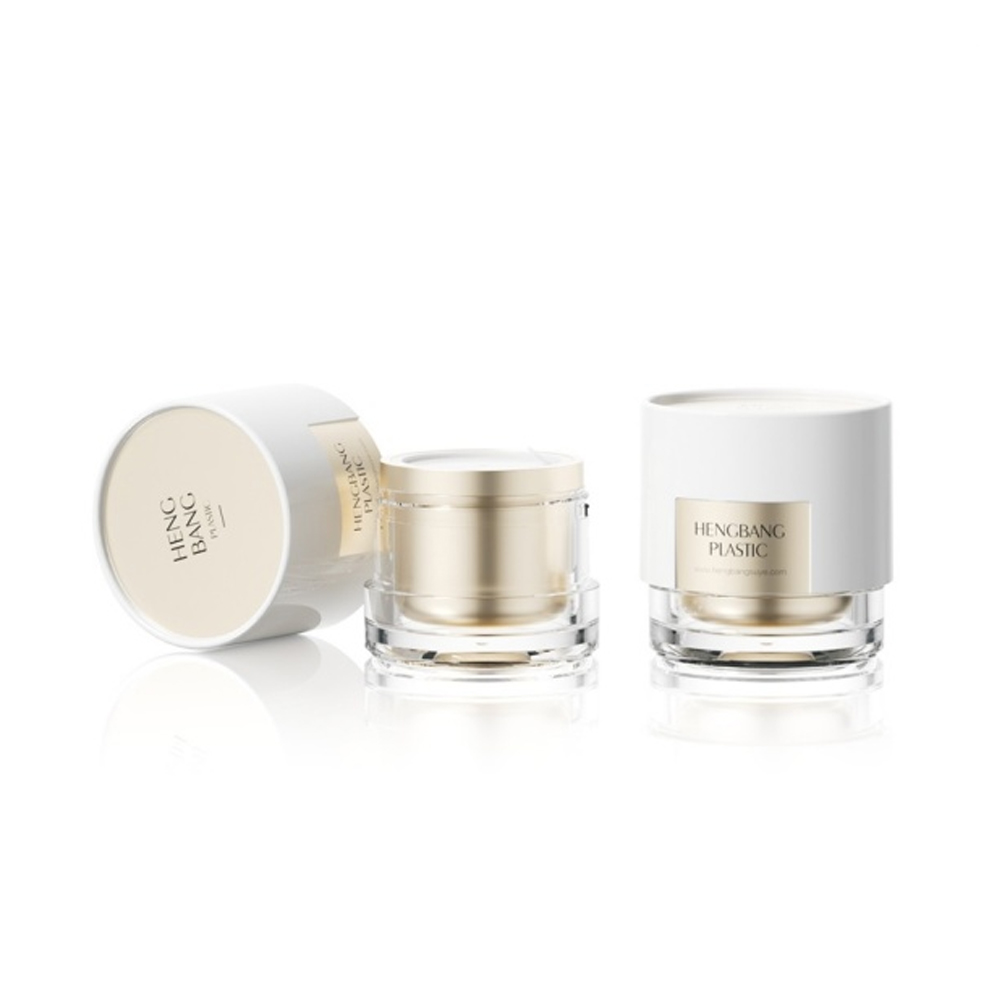 HB-G021 Double-Wall Refillable Cream JarA 30–50 ml refillable cream jar with a tool-free inner PP cup; keep the decorated outer jar and replace only the cup.View Product →
A refillable double-wall cream jar such as HBG021 works on exactly that logic, with an inner cup that lifts out without tools.
Two cautions before you commit. A refill only counts as a refill if the cup releases and reseats easily in the hand; if it takes a coin and a hard twist, consumers will not use it. And recycled-content resin suits the hidden inner cup well, while the visible shell usually stays in virgin material to protect clarity.
Leak complaints usually trace back to a small number of dimensions, and every one of them can be checked on a sample rather than argued about in a meeting.
Then test the way a parcel is actually handled: fill and cap the jars, invert them for 24 hours, drop them from 1 m onto a hard floor in six orientations, and run a vibration test before you lock a pallet configuration.
Settle two details early: whether the decoration sits on the outer shell or on the inner cup, because it changes how refills are priced, and whether the finish survives the alcohol wipe that shoppers use on a tester.
None of this is complicated, but the order matters: formula, then neck finish and liner, then material and wall style, then decoration. Brands that follow that sequence tend to approve a lotion jar in one or two rounds instead of four.
If you would rather compare formats side by side before committing, our container range covers jars, airless bottles and lotion bottles in one place, and we can quote from a drawing, a sample, or simply a viscosity and a target volume.


Copyright © Yuyao Hengbang Plastic Co., Ltd.
All Rights Reserved.
 Wholesale Plastic Cosmetic Packaging Manufacturers