English
 中文简体

News
Home > News > Industry News > Choosing Cosmetic Containers Manufacturers: Specs, Tooling and Lead Times

 2026.11.05
 Industry News
Content
Most container complaints that reach a filling line are dimensional, not decorative: a neck that is out of round by three-tenths of a millimetre, a pump collar that seals at one torque setting but weeps at another, a jar thread that binds after two weeks in a warm warehouse. None of that shows up in a product photo, and all of it is decided long before the first pallet ships.
So a shortlist of cosmetic containers manufacturers is best built on four measurable criteria, in this order:
The sections below explain how those four criteria play out in practice, and where quotes from different suppliers stop being comparable.
Samples are usually approved on appearance and rejected later on function. A 30 ml airless bottle and a 30 ml PETG bottle can carry an almost identical silhouette and behave nothing alike: the airless unit meters product by pump stroke and keeps the formula away from air, which matters for retinol, vitamin C and anything built on volatile silicones; the PETG bottle needs a dip tube, a compatible pump and enough headspace to survive fill temperatures without paneling.
If the mechanism is still undecided, this plain-language explainer on how plastic airless bottles work covers dose accuracy and vacuum retention without the marketing gloss.
Viscosity and pH are the fastest filters. Below roughly 3,000 cps a standard lotion pump is fine; above 20,000 cps you are usually choosing between a squeeze tube, a wide-mouth jar and a high-viscosity airless pump with an enlarged orifice. Acidic formulas below pH 4 tend to attack certain metallised coatings on the actuator, so the decoration specification has to be settled together with the formula, not after it.
| Container format | Typical fills | What to specify |
|---|---|---|
| Airless pump bottle, 7–50 ml | Foundation, serum, retinol, vitamin C | Dose per stroke, orifice diameter, 100% leak check, vacuum retention after 4 weeks at 40 °C |
| Double or triple chamber bottle | Two-phase serums, primer plus foundation | Fill ratio per chamber, mixing head geometry, headspace allowance |
| PETG lotion bottle | Body lotion, cleanser, after-sun | Neck size (20/410 or 24/410), pump dose, decoration method |
| Double-wall acrylic jar | Face cream, body butter, balm | Wall thickness, gasket material (PE or EVA), fill weight versus headspace |
| Refillable airless or jar | Any premium repeat-purchase SKU | Inner pod retention force, reuse cycles for the outer shell, disassembly instructions for the consumer |
| Sunscreen squeeze bottle | SPF fluid, milk, gel | Oval or round profile, flip-top versus screw cap, compatibility with organic UV filters |
| PET or PETG toner bottle | Toner, micellar water, essence | Travel size (15–20 ml) versus 50 ml, mist insert versus plain screw cap |
For foundation and serum lines, a plastic airless foundation bottle in the 15–30 ml band is the usual starting point, with dose and orifice matched to the formula's flow curve rather than to a competitor's bottle.
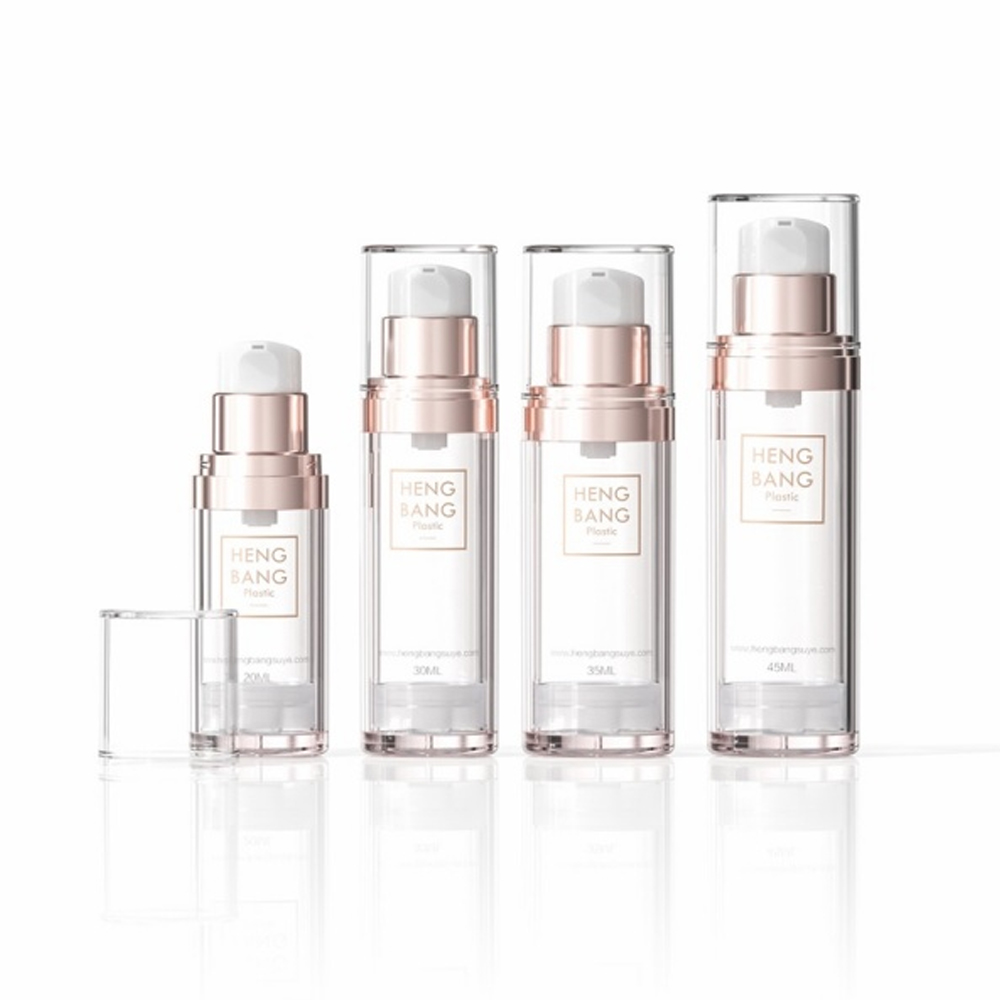 Custom Plastic Airless Foundation Bottle for Serum and Foundation LinesA 20–45 ml airless PETG bottle with 0.23 cc dose, suited to foundation and serum packaging where consistent dispensing and reduced contamination matter.View Product →
Every handoff between vendors adds a week and a set of excuses. When the moulder, the spray-coater and the assembler are three separate companies, a 0.2 mm thread deviation discovered at assembly is traced back through two purchase orders before anyone accepts responsibility — and by then the launch date is already committed to retail.
A vertically integrated plant typically holds the injection machines, the tool room, the coating and printing lines, and the assembly benches for pump, collar and overcap in one building. That matters most for decorated stock: spray coating and UV metallising change the neck diameter slightly, so the pump fit must be validated on the finished, decorated part rather than on the bare moulding.
Vague specifications produce polite arguments. Putting numbers in the order, together with the test method, converts a dispute into a measurement. These are typical figures for cosmetic-grade plastic containers and should be re-confirmed with the supplier for each project:
Ask for the control plan that sits behind these numbers. A supplier who can show gauge repeatability, batch traceability and a documented first-article approval is a different risk category from one who answers with a photo of a certificate on the wall.
Refillable packaging used to be a premium story. It is now increasingly an accounting one. Packaging waste regulations across the EU and several Asian markets are shifting fees toward weight and recyclability, and refill systems reduce rigid plastic per use because the outer shell stays with the consumer. Manufacturers commonly quote rigid-plastic reductions in the 50–70% range when only an inner pod or a refill jar is replaced, though the exact figure depends on shell weight and reuse cycles.
The engineering constraints are less discussed than the savings: the inner pod needs a consistent retention force so it does not drop out in a handbag, the outer shell must survive the decoration process repeatedly without scuffing, and the consumer needs a simple, obvious way to separate the two. Material choice is equally practical — acrylic gives depth and weight for prestige jars, while PET and PETG handle toner and lotion economically. This comparison of acrylic and refillable cream jar options is a useful starting point when the brief lands between the two.
For a cream or balm SKU moving to a refill model, the shell is usually a double-wall jar with a snap-in inner cup that can be lifted out without a tool.
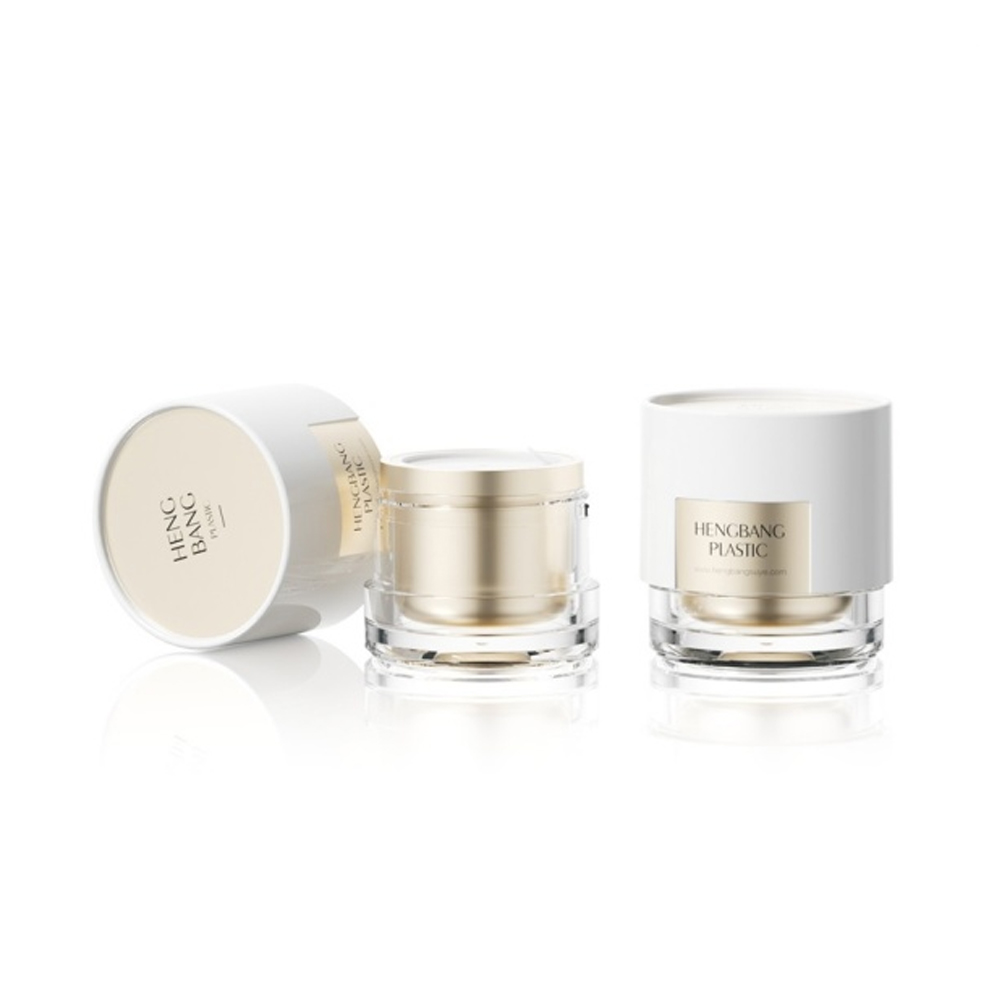 Double Wall Refillable Cream Jar for Eco-Conscious Skincare PackagingA 30–50 ml refillable double-wall jar designed for day and night creams, supporting clean refills and reduced plastic waste for eco-conscious skincare lines.View Product →
Timelines are the part of a quotation most often read as a formality and most often missed. The chart below shows indicative durations for a new tooled container, excluding formulation and artwork approval; a stock mould with a printed label is far quicker, while a bespoke shape with metallised decoration sits at the top of the range.
Read the chart backwards from your retail on-shelf date and the critical path becomes obvious: a change of decoration after mass production starts is not a delay of days, it is a delay of weeks plus scrapped stock. The same logic applies to seasonality. Sunscreen programmes for the northern-hemisphere summer need bottles and caps booked in the first quarter, which is why sunscreen tooling slots fill earlier than general lotion work.
A 30 ml and 50 ml range in one mould family is often the cheapest way to cover both trial and full sizes without doubling tooling spend.
 Custom Empty Sunscreen Bottle in 30 ml and 50 ml SizesA lightweight PP squeeze bottle for sunscreen, with a 30 ml carry-on size and 50 ml daily option, suited to portable everyday sun care packaging.View Product →
Certificates are easy to display and hard to interpret. The useful questions are operational, and a genuine manufacturer answers them without escalation:
Scale helps here only when it is verifiable. Yuyao Hengbang Plastic Co., Ltd., for instance, has been moulding cosmetic packaging in Yuyao, Zhejiang since 2006 and now runs a 35,000 m² site with more than 300 staff; it holds ISO 9001:2015 and ISO 14001:2015 certification and was named a Ningbo high-tech enterprise in 2021. Its catalogue covers 7–50 ml airless bottles, two- and three-chamber bottles, PETG lotion bottles, acrylic double-wall jars, sunscreen squeeze bottles and refillable formats — a spread that makes cross-format comparisons, and shared neck standards, easier than assembling four separate suppliers.
Choosing among cosmetic containers manufacturers comes down to converting soft claims into checkable facts: which format genuinely suits the formula, where the tooling and decoration physically sit, which tolerances appear in the contract, and whether the refill roadmap is engineered or borrowed from a press release. Get those four right and the price conversation becomes a straightforward comparison of like for like — including the cost of the problems you will not have to fix later.


Copyright © Yuyao Hengbang Plastic Co., Ltd.
All Rights Reserved.
 Wholesale Plastic Cosmetic Packaging Manufacturers