

 English
 中文简体
中文简体
News

Industry News
Triple Chamber Airless Bottles: A Full Comparison Guide (2026)
 2026.06.18
 Industry News
Content
- 1 What a Triple Chamber System Actually Does Differently
- 2 How the Three-Zone Pump Mechanism Works
- 3 Why Formula Separation Outperforms Preservative-Based Stability
- 4 Dosing Accuracy Compared Across Chamber Types
- 5 Manufacturing and Cost Differences Worth Planning For
- 6 Which Formulas Actually Justify a Triple Chamber Bottle
- 7 Sustainability Trade-Offs Between Chamber Counts
- 8 Questions to Answer Before Choosing a Triple Chamber Format
A triple chamber airless bottle keeps three separate formulas isolated from each other and from air until the moment they are dispensed, releasing them together through a single pump head in one fixed ratio. It exists to solve one specific problem: how to combine three actives that would degrade, react, or separate if mixed and stored together, without asking the user to blend anything by hand.
What a Triple Chamber System Actually Does Differently
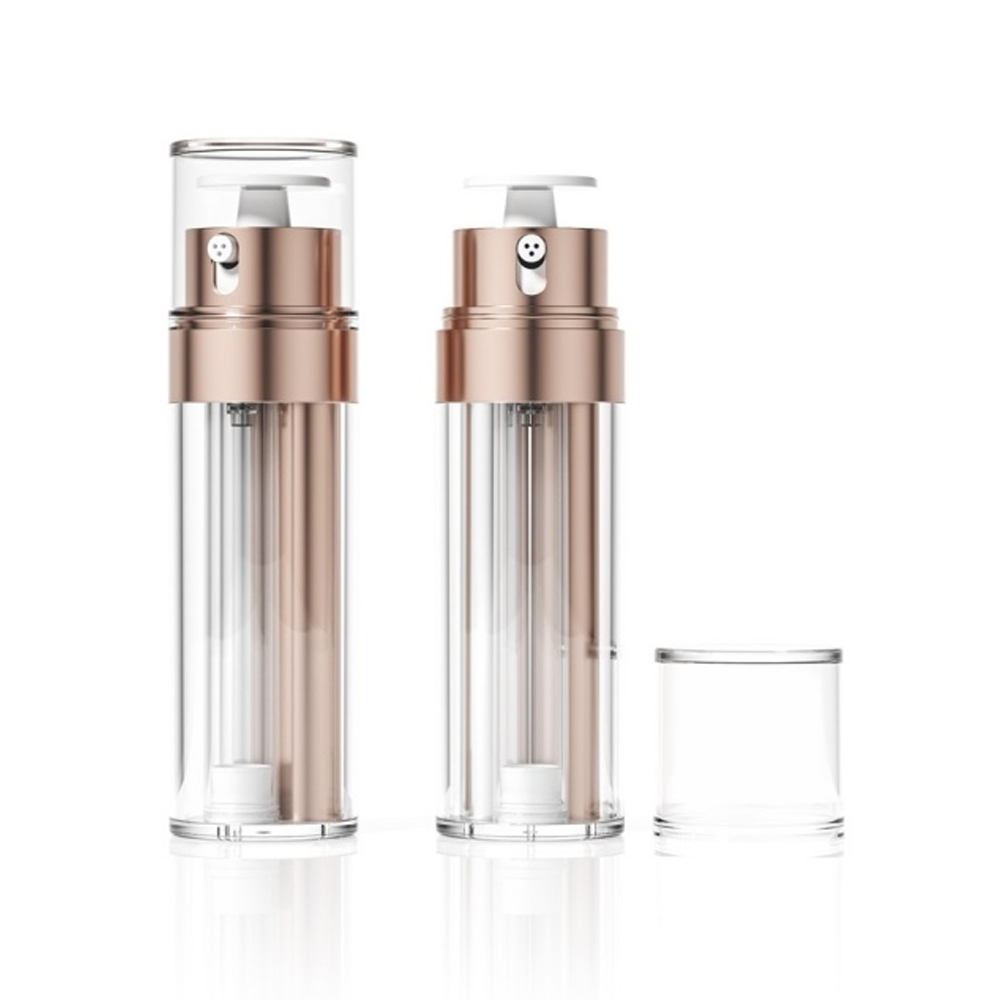
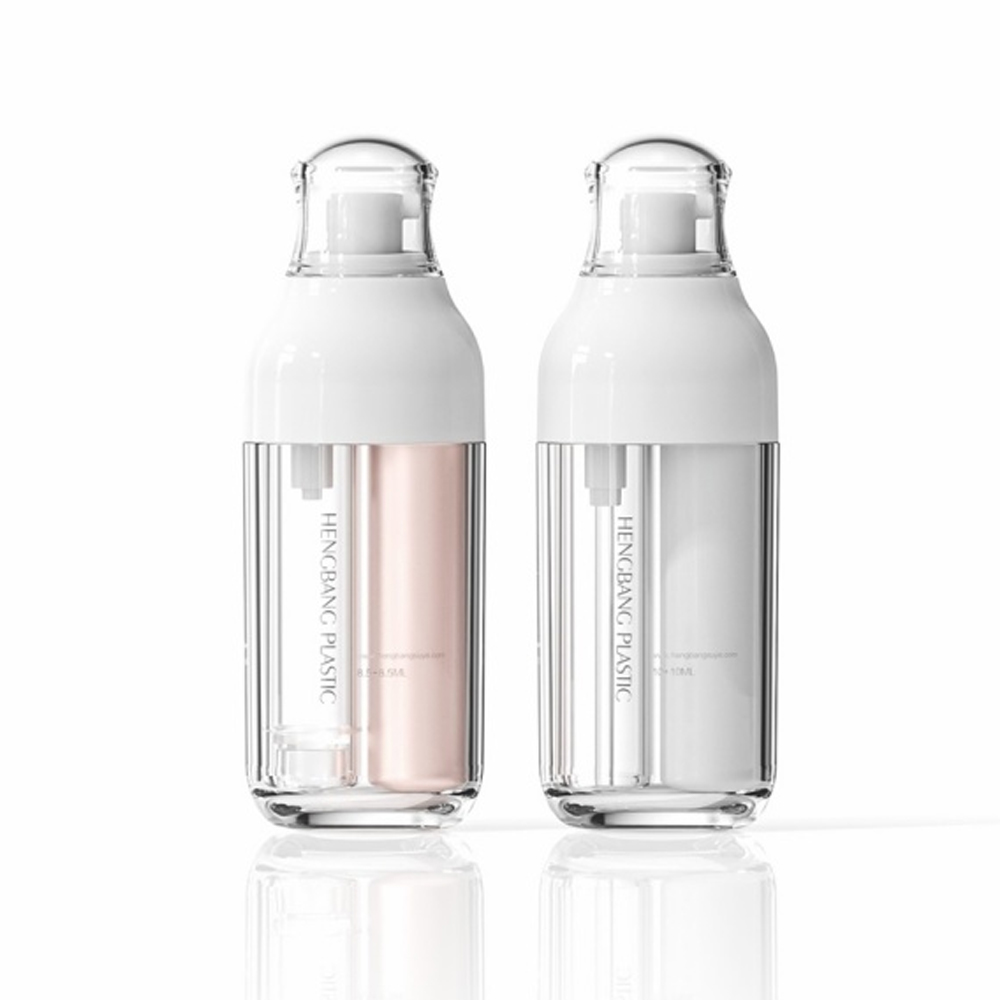
Most packaging solves for one variable — either keeping air out or keeping ingredients apart. A triple chamber airless bottle solves for both at once. Inside the bottle, three independent pistons or bag-in-bottle pouches sit in parallel sleeves, each connected to its own micro-channel that feeds into a shared dispensing nozzle. When the pump is pressed, all three chambers compress simultaneously and release their contents in a pre-calibrated ratio — commonly 1:1:1, but often adjusted to something like 2:1:1 depending on formula concentration.
This differs fundamentally from a dual chamber system, which only separates two formulas, and from a single chamber airless bottle, which relies purely on a vacuum piston to limit oxygen exposure but cannot separate incompatible ingredients at all.
| Feature | Single Chamber | Dual Chamber | Triple Chamber |
| Formulas Kept Separate | 1 (no separation) | 2 | 3 |
| Oxygen Exposure per Use | Low | Low | Low |
| Typical Fill Ratio Control | Not applicable | Fixed or adjustable, 2 streams | Fixed or adjustable, 3 streams |
| Internal Component Count | 3–5 parts | 6–9 parts | 9–14 parts |
| Manufacturing Tooling Cost | Baseline | 1.4–1.8x baseline | 2.2–3x baseline |
| Best Use Case | Stable, single-formula liquids | Two reactive actives (e.g., vitamin C + peptide) | Three-part actives, oils, or serum systems |
How the Three-Zone Pump Mechanism Works
The dispensing head is the part that makes or breaks the design. In a well-engineered triple chamber pump, each chamber has its own check valve and its own capillary tube. When the actuator is pressed, all three valves open at the exact same stroke distance, which is what keeps the output ratio consistent from the first pump to the last. Poorly calibrated units will start dispensing unevenly after 60–70% of the bottle is used, because the pistons don't compress at matched rates once internal pressure drops.
Three design details separate a reliable triple chamber pump from a mediocre one:
- Independent piston travel: each chamber's piston must be mechanically synced to the actuator stroke, not just to spring tension.
- Channel diameter matching: if one micro-channel is narrower than the others, that formula will lag behind and throw off the ratio.
- Dead volume minimization: the tubing between chamber and nozzle should hold as little residual liquid as possible, or the last 5–8% of product becomes unusable.
Why Formula Separation Outperforms Preservative-Based Stability
The conventional way to combine unstable actives — vitamin C with retinol, or an enzyme with an oil-soluble ingredient — is to lower their concentration and load the formula with stabilizers so the mixture survives months on a shelf. Triple chamber packaging takes a different approach: it keeps the actives at full, undiluted concentration and simply never lets them touch until the second they leave the bottle.
Practical comparison: a vitamin C serum blended and bottled as one formula typically loses 20–30% of active potency within 90 days at room temperature. The same vitamin C held in an isolated chamber and combined only at dispensing shows almost no measurable degradation over the same period, because oxidation only begins once it contacts air and the other actives.
Dosing Accuracy Compared Across Chamber Types
Consistency of dose is where triple chamber bottles are judged most harshly, because three streams merging unevenly is far more noticeable than one stream running low.
±3–5%Dose variance, single chamber airless pump
±5–8%Dose variance, dual chamber pump
±7–12%Dose variance, triple chamber pump
That widening variance is the direct cost of added complexity. It can be narrowed with tighter tolerances on piston seals and channel diameters, but it rarely disappears entirely — which is why triple chamber systems are best suited to formulas where a small ratio shift doesn't meaningfully change the result, rather than to actives requiring precise pharmaceutical dosing.
Manufacturing and Cost Differences Worth Planning For
A single chamber airless bottle can often be sourced as a stock component with only the label and cap customized. Dual and triple chamber systems almost always require semi-custom or fully custom tooling, because the internal geometry has to be designed around the specific viscosity and volume ratio of each formula.
| Cost Driver | Typical Impact for Triple Chamber |
| Tooling and mold development | Highest single cost; often 2–3x a standard airless mold |
| Minimum order quantity | Usually higher than single chamber, since molds must be justified across volume |
| Filling line complexity | Requires three synchronized filling heads instead of one |
| Quality control | Each chamber needs independent leak and fill-volume testing |
| Lead time | Typically 4–8 weeks longer than single chamber development |
Which Formulas Actually Justify a Triple Chamber Bottle
Not every multi-ingredient product needs three separate chambers. The decision usually comes down to whether the formula fails one of three tests: oxidation sensitivity, pH incompatibility, or oil-water separation.
- Oxidation-sensitive actives — ingredients like ascorbic acid or certain retinoid derivatives that break down quickly once exposed to air and light.
- pH-incompatible actives — combinations where one ingredient needs a low pH to stay active and another needs a neutral or higher pH, making a single blended formula chemically impossible without compromise.
- Oil-and-water systems that separate on standing — formulas that would need heavy emulsifiers to stay blended, which in turn dilute the actives themselves.
If a formula doesn't hit any of these three problems, a single or dual chamber bottle usually performs just as well at a fraction of the tooling cost.
Sustainability Trade-Offs Between Chamber Counts
More chambers mean more plastic components per unit, which raises the per-bottle material footprint compared to single chamber designs. On average, a triple chamber bottle uses 35–50% more plastic by weight than a single chamber airless bottle of the same external size, because of the internal piston sleeves and channel structures. Against that, triple chamber packaging eliminates the need for three separate single-formula bottles, so when a brand would otherwise be selling three products instead of one combined bottle, the net packaging volume per full regimen can actually be lower.
Questions to Answer Before Choosing a Triple Chamber Format
- Do all three formulas dispense at a viscosity the shared nozzle can handle without one stream lagging?
- Is the ratio between the three actives fixed by the formula chemistry, or could it shift slightly without affecting performance?
- Does the projected order volume justify custom tooling costs versus using three separate single chamber bottles?
- Has the pump been tested through a full use cycle, not just the first and last dose, to confirm ratio consistency doesn't drift?
QUICK
Product Categories
Contact
-
[email protected]

-
+ 86 - 18858081323

-
+ 86 - 574 - 62422802

-
+ 86 - 18858081323

-
No.7 Zhenbei Road, Mazhu Town, Yuyao City, Zhejiang Province, China.

Let’S Co-Create A High-Quality
Future For Cosmetics Packaging.
Copyright © Yuyao Hengbang Plastic Co., Ltd.
All Rights Reserved.
 Wholesale Plastic Cosmetic Packaging Manufacturers