

 English
 中文简体
中文简体
News

Industry News
Sunscreen Packaging Showdown: Plastic Bottles vs Glass Bottles
 2026.05.14
 Industry News
Content
Plastic Sunscreen Bottle vs Glass: Which Packaging Material Performs Better?
For sunscreen products, choosing the right bottle material is crucial for safety, usability, and brand perception. Plastic bottles have become the industry standard, while glass bottles are still preferred for premium lines. Understanding their differences helps manufacturers, retailers, and consumers make informed decisions.
Durability and Safety
Resistance to Breakage
Plastic sunscreen bottles excel in durability. Unlike glass, they are virtually unbreakable under normal handling conditions. This makes them ideal for outdoor and travel use where drops and impacts are common.
Glass bottles, while sturdy, are prone to breaking on impact. A single fall can shatter the bottle, posing risks to consumers and requiring extra packaging for shipping.
UV Protection and Product Safety
Plastic bottles often come in opaque or tinted forms, providing excellent protection against UV degradation of sunscreen. Certain plastics like HDPE and PET offer chemical resistance, ensuring the formula remains stable over time.
Glass bottles offer inherent chemical inertness but require tinted options to shield UV-sensitive ingredients. Clear glass without UV coatings can reduce sunscreen efficacy over time.
Cost and Production Efficiency
Manufacturing Cost
Plastic bottles are significantly cheaper to manufacture than glass. Injection molding and blow molding processes allow high-speed production with minimal labor costs. Average production costs per unit are 40–60% lower than equivalent glass bottles.
Glass bottles require high-temperature furnaces and slower production lines, increasing energy consumption and unit cost. For large-scale sunscreen lines, this can significantly impact overall profit margins.
Logistics and Transportation
Plastic bottles are lightweight, reducing shipping costs by up to 50% compared to glass. They also minimize breakage risks during transit, which reduces losses.
Glass bottles add significant weight and require specialized packaging, increasing shipping expenses and carbon footprint.
Environmental Considerations
Recyclability
Glass is infinitely recyclable without quality loss. Recycling rates for glass bottles often exceed 70% in developed regions. Plastic bottles are recyclable, but recycling efficiency varies widely depending on resin type (PET, HDPE, LDPE) and local facilities.
Carbon Footprint
Plastic bottles generally have a lower carbon footprint during production and transport due to lighter weight and energy-efficient manufacturing. Glass bottles require high heat during production, which generates more CO2 emissions per unit.
User Experience and Design Flexibility
Ergonomics and Portability
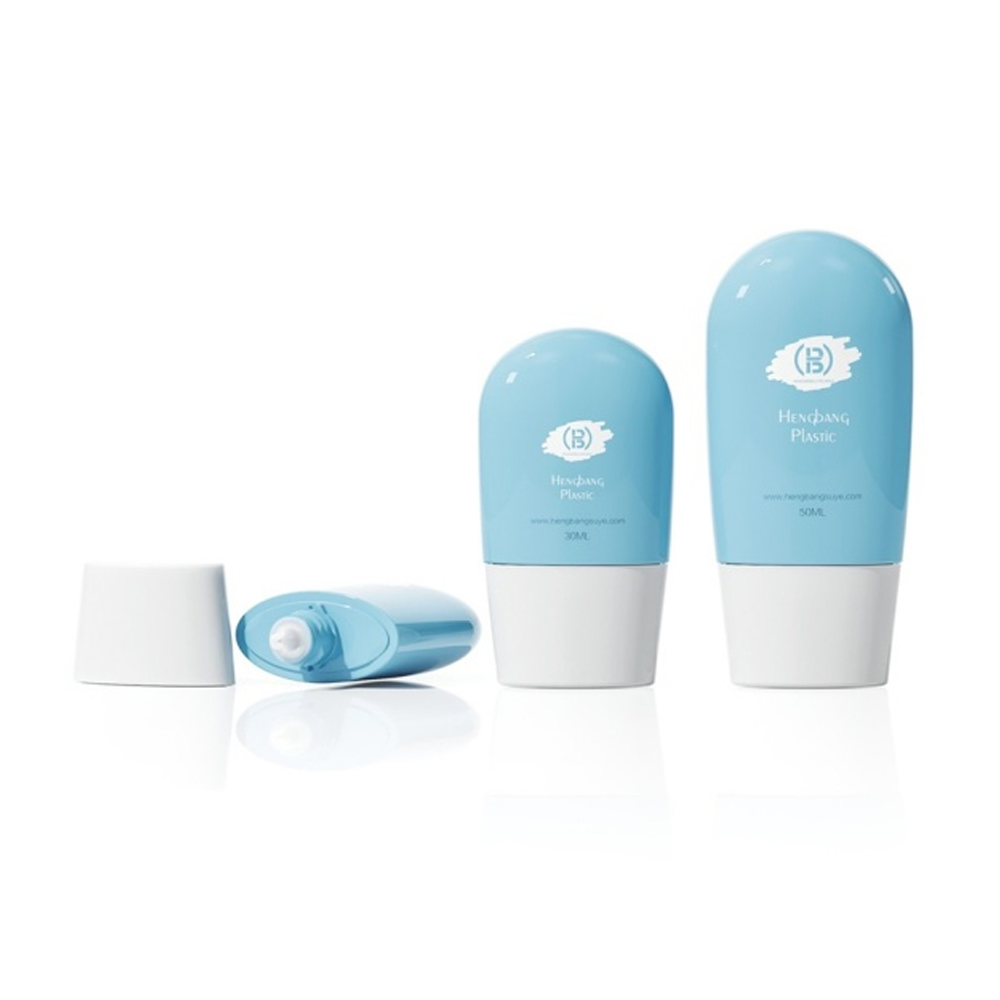
Plastic bottles allow a variety of shapes, squeezable designs, and ergonomic options. Consumers can easily dispense sunscreen without spilling, making plastic ideal for on-the-go use.
Glass bottles are rigid, heavier, and prone to slippage. Pump mechanisms can be added, but portability remains limited.
Aesthetic Appeal
Glass is often preferred for luxury branding due to its high-end appearance and premium feel. Plastic bottles can mimic glass aesthetics using coatings or glossy finishes but generally lack the same weight and tactile perception.
Chemical Compatibility with Sunscreen Formulas
Plastic materials like HDPE, PET, and PP are chemically resistant to most sunscreen formulations, including oils, UV filters, and stabilizers. This ensures long-term product integrity without leaching harmful substances.
Glass is chemically inert and does not react with formulas. However, clear glass may require additional UV protection for light-sensitive ingredients.
Cost-Benefit Comparison Table
| Feature | Plastic Bottle | Glass Bottle |
|---|---|---|
| Durability | High, shatterproof | Low, breakable |
| Cost per Unit | Low | High |
| UV Protection | Excellent with tinted/opaque plastic | Moderate, requires coating |
| Weight & Transport | Lightweight | Heavy |
| Environmental Impact | Lower production CO2, recycling dependent | Infinite recyclability |
| User Convenience | High, squeezable and portable | Moderate, rigid and heavy |
QUICK
Product Categories
Contact
-
[email protected]

-
+ 86 - 18858081323

-
+ 86 - 574 - 62422802

-
+ 86 - 18858081323

-
No.7 Zhenbei Road, Mazhu Town, Yuyao City, Zhejiang Province, China.

Let’S Co-Create A High-Quality
Future For Cosmetics Packaging.
Copyright © Yuyao Hengbang Plastic Co., Ltd.
All Rights Reserved.
 Wholesale Plastic Cosmetic Packaging Manufacturers